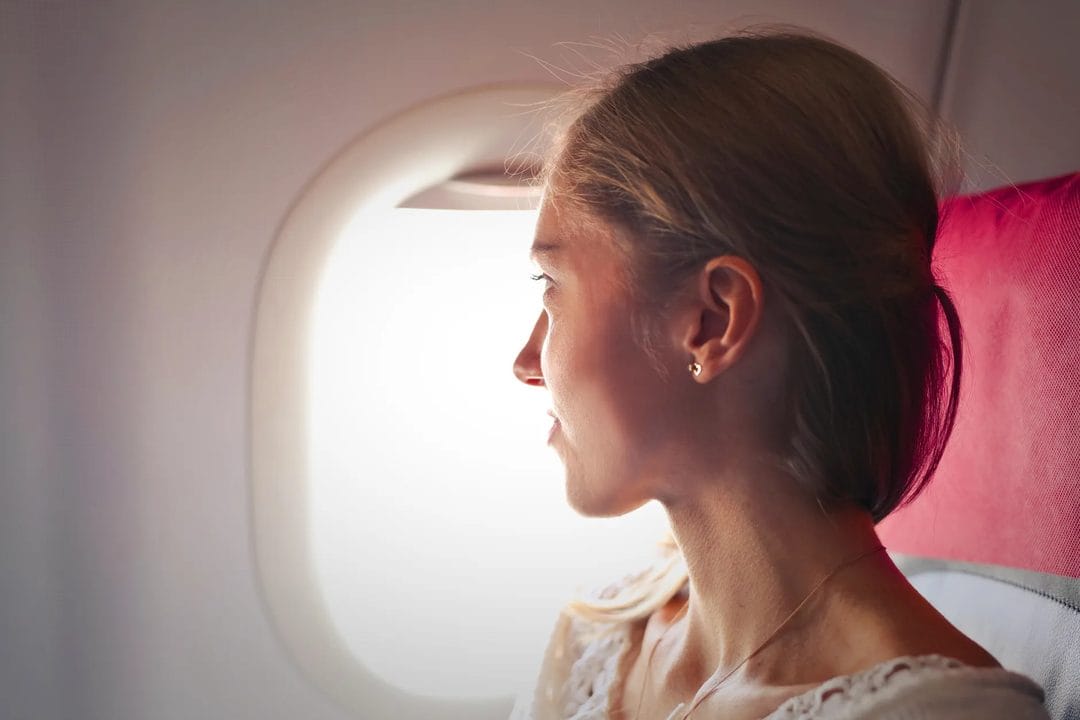
Cabin humidity on a typical commercial flight sits between 10 and 20 percent — drier than the Sahara Desert, which averages closer to 25 percent even at its harshest. That number surprises most people, and it explains why skin that looks fine at the gate can feel tight, flaky, and dull by the time the plane starts its descent. Add recycled air, pressurised at the equivalent of 6,000 to 8,000 feet altitude, and you get a face that's losing water faster than it can replace it.
What's actually happening to your skin at 35,000 feet
The dryness isn't really about the air being "dirty" — most modern aircraft use HEPA filters that exchange cabin air every two to three minutes, which is more filtration than most offices ever see. The real issue is humidity, or the near-total lack of it. Your skin's outer layer, the stratum corneum, relies on ambient moisture to stay flexible; strip that away for four or five hours and transepidermal water loss accelerates, pulling moisture out of the skin faster than your barrier can hold onto it. That's why long-haul flights feel worse than short hops — the effect compounds the longer you're exposed, and a six-hour transatlantic flight does noticeably more damage than a ninety-minute domestic one.
Cabin pressure adds a second layer to the problem. At altitude, blood vessels near the surface of the skin can dilate slightly in response to the lower oxygen levels, which is part of why some travellers land with a flushed, puffy face — not an allergic reaction, just circulation adjusting to thinner air. Combine that with sitting still for hours, and fluid retention around the eyes and cheeks becomes almost universal by hour three of any flight over four hours.
The skincare mistakes that make it worse
Skip the exfoliating acids and retinoids on travel days — glycolic acid, lactic acid, and retinol all thin the outermost skin layer slightly, which is exactly the layer you need intact when cabin air is actively pulling moisture out of it. Apply either the morning of a flight and you're flying with a compromised barrier for the entire journey. The better move is a plain, occlusive-heavy routine: something like CeraVe Healing Ointment ($17) or Aquaphor ($14) sealed over a hydrating serum locks moisture in rather than relying on the cabin air to leave any behind for your skin to absorb.
Face mists are oversold as an in-flight fix, and here's the part most travel guides skip: spraying water onto already-dry skin without an occlusive layer on top can make things worse, not better, because the water evaporates and takes even more moisture from your skin with it as it does. If you're going to mist, follow it immediately with a barrier cream — Avène Thermal Spring Water ($19) followed by a thin layer of Vaseline or CeraVe Moisturising Cream works considerably better than either product alone.
Foundation and powder makeup make the dryness more visible, not less — thicker under-eye concealer especially tends to crease into fine lines that the low humidity has already made more pronounced. If you're flying somewhere you'll need to look presentable on arrival, apply makeup after landing rather than before boarding; a bare, well-moisturised face survives a five-hour flight far better than a full face of foundation does.
What's worth doing, and what isn't
- Drink water on a schedule, not when you feel thirsty — cabin dehydration outpaces thirst signals, and a general rule of 8 ounces per hour of flight time keeps you ahead of it rather than catching up.
- Skip the sheet mask mid-flight. It looks great on social media, but a sheet mask needs 15–20 uninterrupted minutes of contact and most people end up removing it early for the beverage cart or a bathroom trip, which wastes most of the active ingredients.
- A rich lip balm matters more than people expect — Laneige Lip Sleeping Mask ($24) or plain Aquaphor on lips prevents the cracking that shows up hours before your face even feels dry, since lips have no oil glands of their own.
- Avoid alcohol on long flights if clear skin at landing matters to you. It's a diuretic on top of an already dehydrating environment, and the combination is worse than either factor alone.
Skip the claim that a single flight "ages your skin by a decade" — that's the kind of number that gets repeated in headlines with no study behind it. What actually happens is temporary: increased transepidermal water loss and a stressed barrier that mostly recovers within 24 to 48 hours with normal hydration. Chronic frequent flyers — flight crew, consultants doing three flights a week — are a different story, since the cumulative barrier stress doesn't get a full recovery window between trips. For someone flying twice a year for a summer holiday, the damage is real but temporary, not the accelerated-ageing narrative that gets sold alongside overpriced airport skincare kits.
Building a travel kit that actually earns its space
Carry-on liquid restrictions cap everything at 100ml (3.4oz) per container, which rules out most full-size moisturisers but works fine for the ingredients that matter most on a flight. A travel-size ceramide cream, an occlusive balm, and a hydrating mist cover the entire in-flight window without breaking the liquids limit, and skipping everything else in your regular ten-step routine for one flight won't undo months of consistent skincare.
Sunscreen is worth packing even for a night flight, not for the flight itself but for the layover and landing — airport terminals have more glass and UV exposure than people assume, especially on connections with long walks between gates. A mineral SPF like EltaMD UV Clear ($42) travels well because it doubles as a light moisturiser, which matters when your kit needs to do more with fewer products. Skip anything with a strong fragrance for the flight itself; scent-heavy products in a sealed cabin environment are one of the more common sources of mid-flight headaches for the passenger sitting next to you, not just for you.
The post-flight reset
Landing with tight, flaky skin doesn't mean starting an aggressive routine immediately — a stressed barrier needs gentle rebuilding, not a fresh round of actives thrown at it. Cleanse with something non-foaming like La Roche-Posay Toleriane Hydrating Gentle Cleanser ($17), apply a ceramide-rich moisturiser, and hold off on retinol or vitamin C serums for at least 24 hours. Most people want to "fix" travel skin with more product, when what it actually needs is less product and more time.
Puffiness around the eyes usually resolves on its own within a few hours of normal movement and rehydration — a cold jade roller or chilled eye gel patches can speed that along, but neither is doing anything a good night's sleep and a large glass of water wouldn't do just as well, only slower. Where people go wrong is treating post-flight puffiness like a skin problem instead of a circulation-and-fluid one; no serum fixes fluid retention, no matter what the packaging implies.
Does seat position or cabin class actually change any of this
Business and first-class cabins aren't meaningfully more humid than economy — the air handling system serves the whole aircraft, so a lie-flat seat doesn't protect your skin barrier any better than an economy seat does. What premium cabins do offer, on longer routes, is room to apply a proper skincare layer mid-flight without elbowing a stranger, and some airlines stock better amenity kits with a genuine moisturiser instead of a token lip balm. Window versus aisle makes essentially no difference either, despite the occasional claim that window seats sit closer to a cold surface and dry out faster — cabin air circulation evens this out well before it reaches your skin.
Where seat choice does matter is proximity to the galley and lavatories, both of which see more foot traffic and marginally more airflow disruption; a middle-of-the-cabin seat away from either tends to have slightly more stable air, though the difference is small enough that it shouldn't factor into how you book a flight. The more useful lever is simply flight duration and layover structure — a nonstop with one long block of dry air does less cumulative damage than two shorter connecting flights with a rushed layover in between, since each boarding and descent cycle restarts the pressure and humidity swing your skin has to adjust to.