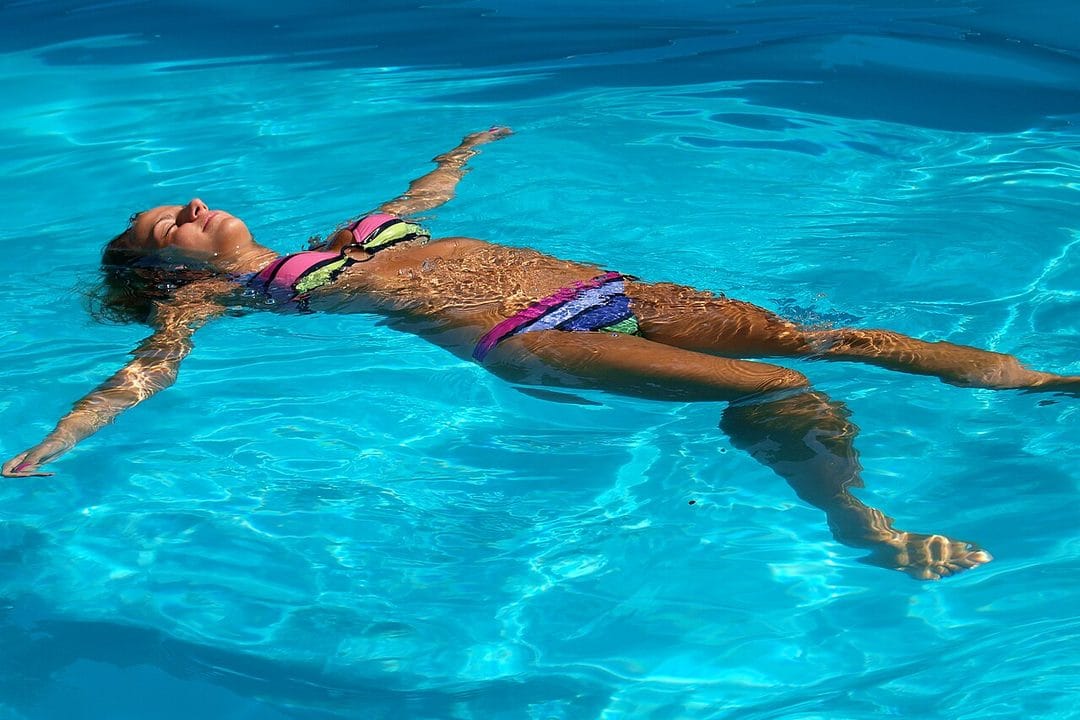
Twenty minutes into a pool day, your skin already feels different — tighter across the cheeks, a little squeaky under your fingertips, like the moisture got pulled out from underneath it. That's not dehydration in the way sunburn or dry desert air causes it. It's a direct chemical strip job. Pool water sits at a pH between 7.2 and 7.8 by design, and public pools in the US are required to hold free chlorine at 1 to 10 parts per million under CDC guidelines, while your skin's own surface runs closer to 4.5 to 5.5. That gap matters more than most people realize: your skin's acid mantle — the thin, faintly acidic film of sebum and sweat that keeps bacteria out and moisture in — gets neutralized almost the moment you submerge.
Hair takes a different kind of hit. Chlorine doesn't just sit on the strand — it oxidizes the protein bonds inside the cuticle, lifting the outer scales and leaving the shaft more porous than it was that morning. Porous hair grabs water fast and loses it just as fast, which is why hair that felt fine in the shower can turn straw-like within an hour of drying in the sun. And because chlorine bleaches pigment slightly with repeated exposure, a summer of regular swims can leave brunette hair with a faint reddish cast and blonde hair visibly lighter by August. None of this is really "chlorine damage" in the vague way it gets talked about at the pool deck. It's a specific, predictable chemical process, and once you understand what's actually happening, protecting against it stops being guesswork.
Why Blonde and Color-Treated Hair Turn Green (It's Not the Chlorine)
Ask anyone who's spent a summer as a regular swimmer and they'll tell you chlorine turns light hair green. It doesn't — not directly. The tint comes from copper, either from algaecides added to pool water or from copper piping and fittings corroding slightly over a swimming season, and chlorine's role is mostly to speed up how fast that copper oxidizes and binds to the hair shaft. Porous, previously bleached, or gray hair picks up copper fastest because the cuticle is already lifted and has more surface area for metal ions to grab onto, which is exactly why platinum blondes and anyone fresh out of a bleach appointment get hit hardest. A chelating shampoo — something formulated specifically to bind and rinse away metal ions, like Malibu C's Swimmers Wellness treatment or Ion's Anti-Swimchlor — clears it in a way a regular clarifying shampoo can't, because standard sulfates lift buildup but don't neutralize copper the same way. Salons that see a lot of swimmers tend to recommend running one of these treatments every one to two weeks through peak pool season rather than waiting until the tint is already visible.
Skip the vinegar-rinse folk remedy some salons still recommend. Diluted acetic acid does very little against bound copper ions and mostly just leaves hair smelling like a salad for the rest of the day.
Protecting Skin Before You Get In the Water
The single highest-leverage habit — and almost nobody does it — is a plain water rinse for a full 60 seconds before you get in. Wetting your skin and hair with fresh water first means they absorb less pool water once you're submerged, the same way a sponge that's already saturated holds less of the next liquid it meets. Follow that with a thin layer of a fragrance-free, occlusive moisturizer like Vanicream or CeraVe's Healing Ointment on cheeks, elbows, and any patch of skin that tends to run dry — it acts as a physical barrier between chlorinated water and your skin, not unlike the way open-water swimmers use petroleum jelly before races in cold conditions. Sunscreen still goes on regardless of any of this; a water-resistant mineral formula such as La Roche-Posay's Anthelios Mineral or Sun Bum's Mineral SPF 50 holds up better across repeated dunks than a chemical formula that can wash off and re-sensitize skin to chlorine at the same time.
If you use retinoids, exfoliating acids, or benzoyl peroxide, skip them the night before a pool day. Combining active ingredients that already thin the outer skin layer with chlorine's own stripping effect is a fast way to end up red and stinging by the second lap.
The Barrier Trick for Hair That Actually Holds Up
Wet your hair thoroughly before you get in, the same logic as with skin, and work through a leave-in conditioner with dimethicone or another silicone high on the ingredient list — Olaplex No.0 or Briogeo's Farewell Frizz both do this well. Silicones coat the hair shaft and create a barrier that chlorinated water struggles to penetrate, which is a meaningfully different mechanism than a watery leave-in spray that mostly evaporates within minutes of getting wet. Braiding or tying hair up before swimming helps too, mostly because it limits how much surface area is exposed to moving water over the course of a swim, and a swim cap solves the problem more completely for anyone swimming laps rather than floating around for an afternoon.
The 20-Minute Repair Window After You Get Out
There's a reason the first twenty minutes after you towel off matter more than anything you did beforehand.
Rinse with clean, cool-to-lukewarm water as soon as you're out of the pool — hot water opens the cuticle further and strips away more of your skin's remaining natural oils, which is the opposite of what you want after an hour of chlorine exposure. Follow with a gentle, sulfate-free cleanser rather than a harsh clarifying shampoo every single time; save the clarifying wash for once or twice a week. The faster daily fix is a hydrating conditioner left on for a full three to five minutes, not the fifteen seconds most people give it while rushing to get back outside. On skin, pat dry rather than rubbing, then reapply the same fragrance-free moisturizer from before the swim while skin is still slightly damp — that traps water at the surface instead of letting it evaporate straight into the pool deck air, and it's worth checking for any tightness or flaking around the eyes and mouth while you do, since thinner skin there loses its barrier fastest.
What a Full Summer of Repeated Exposure Actually Does
One pool afternoon is a minor, reversible stress on skin and hair. Ten or fifteen of them between June and September add up differently, and this is where most of the visible summer damage people blame on sun actually comes from chlorine instead. Keratin — the structural protein in both hair and nails — loses tensile strength with repeated oxidative exposure, which is why hair that swam all June starts snapping mid-shaft by August instead of just feeling dry at the ends. Split ends multiply faster on regularly chlorinated hair because the weakened cuticle can no longer protect the cortex underneath, and once a strand splits, conditioner and oils can only smooth the appearance rather than reverse the structural loss. Scalps take a quieter version of the same hit: chronic dryness from repeated chlorine exposure can trigger flaking that looks like dandruff but is really just a stripped, irritated barrier reacting to a chemical it never fully recovers from between swims.
A weekly bond-building treatment — Olaplex No.3 or K18's leave-in mask are the two most reached-for in this category — rebuilds some of that internal protein structure rather than just coating the surface, and it's worth the ten extra minutes if you're swimming more than twice a week through peak summer.
The Nail and Cuticle Damage No One Talks About
Nails are keratin too, and pool water treats them the same way it treats hair: stripping moisture and leaving the plate more brittle by the end of a swim season. Cuticles dry out and crack first, since they're thinner and have less natural oil coverage than the nail plate itself, and once a cuticle splits it opens the door to hangnails and, occasionally, infection around the nail fold. Gel and acrylic manicures make this worse rather than better during pool season — the seal traps moisture underneath in a way that softens the natural nail, and repeated water exposure can lift the edges of the gel faster than it would in a dry climate.
Rub a cuticle oil like OPI's Avoplex or Sally Hansen's Vitamin E Nail & Cuticle Oil into the nail folds every night through the summer, not just before a manicure appointment. It's a thirty-second habit, and it's the difference between cuticles that stay flexible through August and ones that start splitting by July.
Ocean and Lake Water Isn't the Safe Alternative It Seems
Switching to the ocean doesn't sidestep this problem, even though it feels like the more "natural" option. Saltwater is hypertonic relative to skin cells, meaning it pulls moisture out through osmosis rather than chemical oxidation, and the end result — tight, dehydrated skin and coarser-feeling hair — looks similar even though the mechanism behind it is different. Lake and river water isn't chlorinated, but it usually carries more bacteria and algae, and swimming in it without a rinse afterward tends to cause more breakouts and scalp irritation than a chlorinated pool does over the same amount of time.
The rinse-and-moisturize routine above works across all three, because the fix was never really about neutralizing chlorine specifically. It's about replacing what any body of water strips away, one way or another.