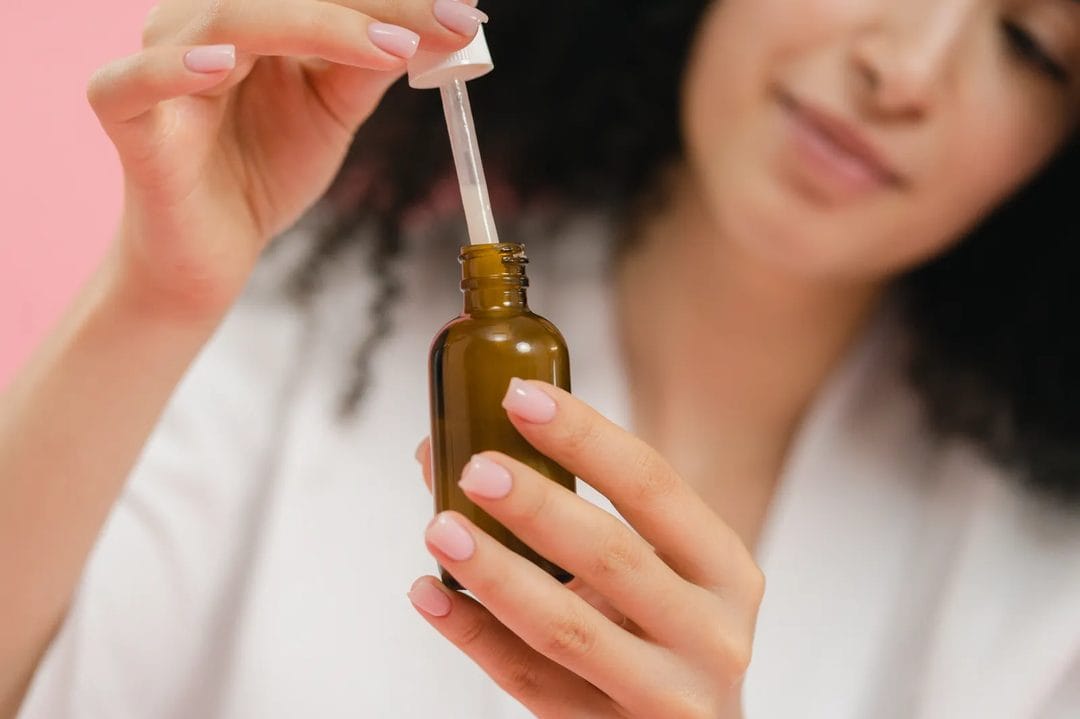
Walk down the serum aisle at Ulta and count how many bottles say "peptide" on the label. CeraVe has three. The Ordinary has at least four. Olay's entire Regenerist line leans on the word like it's a single ingredient instead of a category that spans dozens of completely different molecules doing completely different jobs. Some peptides tell your skin to make more collagen. Some act like a diluted, topical version of Botox. Some are copper-carrying antioxidants your body already makes and stops producing as much of after your mid-twenties. None of them work the same way, and the marketing rarely bothers to say which one is in the bottle you just paid $24 for.
What a Peptide Actually Is, Chemically
Peptides are short chains of amino acids — the same building blocks that link up into the longer chains we call proteins, including collagen and elastin. When collagen in your skin breaks down naturally (through UV exposure, age, or just time), it releases tiny fragments of itself. Your skin reads those fragments as a distress signal and ramps up collagen production to repair the damage. Cosmetic chemists figured out they could synthesize those same fragments in a lab and add them to a cream, essentially tricking your skin into starting repair mode without actual injury. That's the basic premise behind "signal peptides" like Matrixyl. Other peptide categories work through entirely different mechanisms, which is the part most product descriptions skip.
Matrixyl 3000: The One That Started the Trend
Matrixyl 3000 is a combination of two peptides — palmitoyl tripeptide-1 and palmitoyl tetrapeptide-7 — designed to mimic the collagen-breakdown fragments described above. It's the peptide complex you'll find in The Ordinary's Multi-Peptide + HA Serum ($19.90 for 30ml, the product formerly branded as "Buffet"), and it shows up in dozens of drugstore anti-aging creams because it's cheap to formulate with and has more published research behind it than most competing actives. The pitch is straightforward: stimulate collagen and elastin production, support the extracellular matrix, improve firmness over weeks of consistent use. It won't do anything for active breakouts or hyperpigmentation — that's not its job, and creams that claim otherwise are stretching the ingredient past what it's studied for.
Buy the CeraVe Skin Renewing Peptide Cream ($20.89 at Ulta for 48g) if your skin is also dry and barrier-compromised, since it pairs its peptide complex with three essential ceramides. Buy The Ordinary's serum instead if you already have a moisturizer you like and just want the peptide layer underneath it — the difference in packaging changes how you'd actually use each one, not just the price.
Copper Peptides: The One With the Antioxidant Angle
Copper peptides — specifically GHK-Cu, or copper tripeptide-1 — occur naturally in human blood plasma, and levels measurably decline as you age, which is part of why they got adopted into skincare in the first place. Lab and animal studies have shown GHK-Cu stimulates fibroblasts (the cells responsible for producing collagen, elastin, and glycosaminoglycans), acts as an antioxidant, and reduces inflammatory markers like TNF-alpha and interleukin-6 in cell cultures. That's genuinely interesting science. It's also, as one dermatologist reviewing the research put it in a video breakdown of the evidence, "largely limited to lab-based studies, cells in a dish, and small animal models" — meaning the mechanism is plausible but the large-scale human clinical trials that would confirm real-world results on actual faces are still thin on the ground.
Practically, this means treating copper peptide serums as a reasonable bet rather than a proven fix. Formulations sit anywhere from drugstore multi-peptide serums that include a small percentage alongside other actives, up to dedicated copper peptide serums running $30 and up. One caution that actually matters: copper ions can destabilize vitamin C and oxidize it, so don't layer a copper peptide serum directly on top of your ascorbic acid serum in the same routine. Use vitamin C in the morning, save copper peptides for a different part of your evening rotation, and you avoid the interaction entirely.
Argireline: "Botox in a Jar," Minus the Actual Botox
Argireline — the INCI name is acetyl hexapeptide-8 — earned its nickname honestly, if a little dramatically. It's a synthetic peptide built to mimic a fragment of a protein called SNAP-25, and it works by interfering with the SNARE complex that nerve endings use to trigger muscle contraction. A 2006 study published in FEBS Letters demonstrated that Acetyl Hexapeptide-8 inhibited SNARE complex formation in a cell-free lab system, which is the mechanism the entire "topical Botox alternative" marketing category is built on. The effect is real but nowhere close to injectable botulinum toxin in scale — you're not paralyzing a muscle, you're applying a topical compound that may modestly reduce the depth of expression lines with consistent twice-daily use over several weeks. It shows up in The Ordinary's Multi-Peptide + HA Serum alongside Matrixyl, and in plenty of "instant" eye creams whose overnight-results claims outrun what the ingredient itself has been shown to do.
The Problem Nobody in the Marketing Wants to Explain
Most peptides on the market are probably too big to get where they're supposed to go.
That's not a typo, and it's not a niche objection from one skeptical chemist — there's a real scientific debate about whether topical peptides can even reach the layer of skin where they'd need to act. The 500 Dalton rule, established by Bos and Meinardi's 2000 paper in Experimental Dermatology, holds that molecules larger than 500 Daltons generally can't pass through the stratum corneum — your skin's outermost barrier — through passive diffusion alone. Palmitoyl pentapeptide-4, the peptide inside Matrixyl, weighs in at roughly 802 Daltons. That's well over the cutoff, and it means the bioavailability of Matrixyl at the depth where collagen is actually produced remains scientifically unproven, even though the ingredient has decades of manufacturer-funded studies behind it. Some newer research using advanced imaging has detected peptide penetration into the stratum corneum in small studies, and the palmitoyl tail on many cosmetic peptides does increase their lipid solubility, which may help partitioning into the skin's outer layers even if it doesn't guarantee delivery to living dermal cells. Nobody in this field claims certainty in either direction, and any product copy that tells you otherwise is oversimplifying an open question.
Building an Actual Routine Around This
Skip products that list a peptide fifteenth on the ingredient list behind three fragrance compounds — that's a marketing peptide, not a functional dose. Look instead for products built specifically around a named peptide complex, where the brand states the technology on the front of the box: Matrixyl, Argireline, or a copper peptide concentration. A workable routine looks like this: vitamin C serum in the morning under sunscreen, a Matrixyl or Argireline-based serum most evenings, and — if you're using a copper peptide product — reserve it for alternating nights so it never sits directly against your vitamin C or a strong exfoliating acid.
None of this needs to be expensive. The Ordinary's $19.90 serum covers Matrixyl and Argireline in one bottle, and CeraVe's peptide cream at roughly $21 layers a barrier-supporting ceramide blend on top of a comparable signal-peptide complex. Olay's Regenerist Micro-Sculpting Cream, which runs anywhere from $24 to $34 depending on the retailer and current promotion, pairs its amino-peptide complex with niacinamide, which is a genuinely useful combination if you also want some help with tone. Paying three times that at a department store counter for a serum using the same handful of well-studied peptides isn't buying you better science — it's buying you a nicer box.
What to Actually Skip
Growth factor serums marketed as "next-level peptides" deserve real skepticism. Epidermal growth factor and similar molecules are technically peptides, but at roughly 7,000 Daltons they're fourteen times over the penetration cutoff discussed above — even the more optimistic researchers studying peptide delivery aren't claiming these reach living skin cells from a jar. If a product's entire pitch rests on a growth factor blend and a price tag north of $80, that's not where your money should go this year. Put it toward a Matrixyl serum with a decade of published formulation data behind it instead, or a copper peptide product from a brand that states its concentration rather than hiding behind the phrase "peptide complex" with no numbers attached.