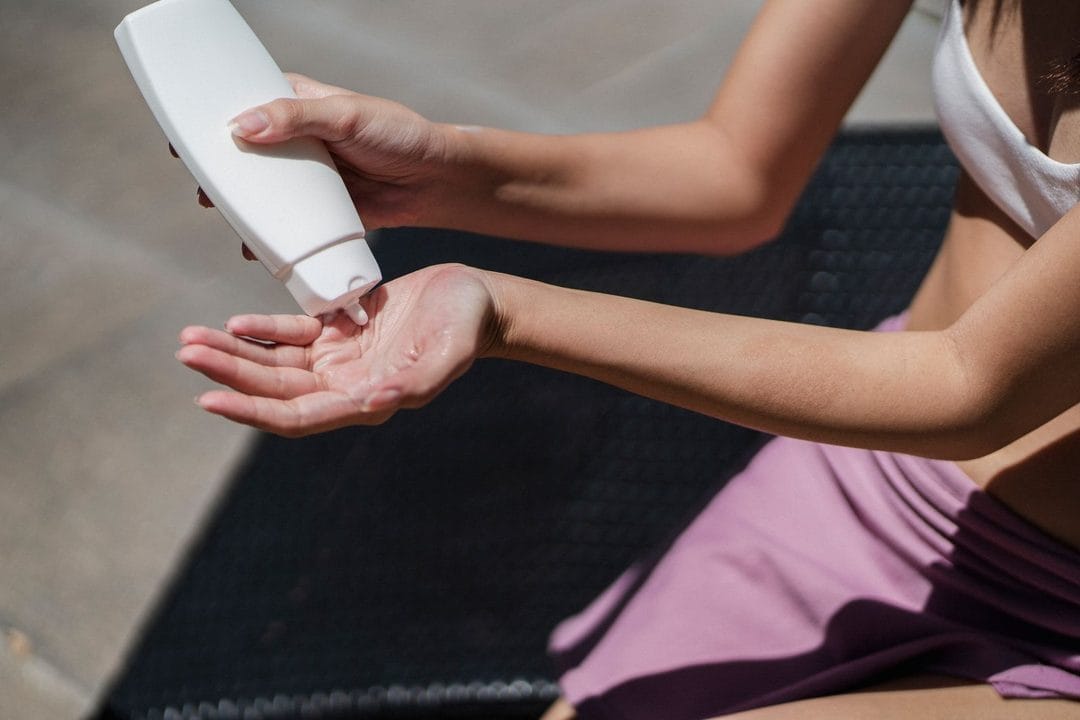
You reapplied sunscreen at 9 a.m. before leaving the house. By the time you're ordering iced coffee at noon, the SPF on your face has already dropped well below the number on the bottle — and you probably have no idea, because nothing about your skin looks different yet. That gap between "I put on sunscreen" and "I'm actually protected" is where most sun damage quietly happens, and it has almost nothing to do with how expensive your bottle was.
The Two-Hour Rule Nobody Actually Follows
Dermatologists have repeated the same instruction for years: reapply sunscreen every two hours when you're outside, and immediately after swimming, sweating, or towel-drying. Almost nobody does this in practice, and the reasons are rarely about laziness — a morning application before the school run or the commute simply becomes the only application of the day, and by mid-afternoon you're wearing what amounts to a thin, broken-down film that offers a fraction of its original SPF. Chemical filters like avobenzone and octinoxate degrade under continuous UV exposure, and avobenzone in particular can lose a meaningful share of its effectiveness within one to two hours of direct sun unless it's stabilized with something like Helioplex or Mexoryl. Mineral filters — zinc oxide, titanium dioxide — hold up a bit better chemically, but they still rub off on pillows, collars, and phone screens at roughly the same rate as anything else. Sweat carries filters away faster than most people expect, even the "sweat-resistant" formulas, because resistance ratings only guarantee performance for a fixed window, usually 40 or 80 minutes, not indefinite protection. And humidity makes it worse: the more your skin perspires without you noticing, the faster a chemical filter emulsifies and slides off with it.
The reapplication window isn't a suggestion designed to sell more sunscreen — it's a reflection of how these ingredients behave under real UV load, and skipping it is the single biggest reason people who "always wear SPF" still end up with sun damage by their late thirties.
Powder SPF and Setting Spray: What They Can (and Can't) Do
Once you're wearing makeup, the two-hour rule gets complicated fast, and this is where most reapplication advice quietly falls apart. Brands like Colorescience and Supergoop! sell pressed mineral SPF powders specifically for touch-ups over makeup, and they do add a layer of physical protection — but they cannot replicate the SPF number printed on the label unless applied in a thickness nobody actually wears on their face. That thickness standard, 2 milligrams per square centimeter of skin, is how every SPF rating gets tested in the first place, and a light dusting of powder gets nowhere close.
Here's the honest version: powder SPF and setting sprays are a real improvement over doing nothing, but they're a maintenance layer, not a replacement for your morning application. Reapply your actual sunscreen — the cream or fluid, not just the powder — at least once around midday if you're spending real time outdoors, even over makeup. It blends in more easily than people expect; press it in with a damp sponge rather than rubbing, and it won't disturb foundation the way a full reapplication used to.
The Right Amount, Every Time
Most people are applying roughly half the sunscreen the SPF number on the bottle assumes.
The American Academy of Dermatology's benchmark is a shot glass — about one ounce — for full body coverage, and around a quarter teaspoon for the face and neck alone. Most people use somewhere between a quarter and a half of that amount, which means an SPF 50 sunscreen applied thinly can perform closer to an SPF 15 or 20 in real-world conditions. That's not a minor rounding error; it's the difference between meaningful protection and a placebo with good branding. Under-application is arguably a bigger problem than skipping reapplication altogether, because it hides in plain sight — the bottle says 50, the box says broad-spectrum, and nothing about the routine feels wrong. If you've been buying SPF 50 for years and still tan or burn by August, the formula probably isn't the issue. The amount almost always is, and it's worth actually measuring a quarter teaspoon once with a real spoon so you know what that amount looks like on your palm.
Products like EltaMD UV Clear ($40) or La Roche-Posay Anthelios Melt-in Milk ($36) are formulated to be worn at that full quarter-teaspoon dose without feeling heavy, which is exactly why dermatologists keep recommending them over drugstore alternatives that go on thick and greasy at the correct amount.
Sun Exposure Math: Why Reapplication Timing Isn't Fixed
The two-hour rule assumes moderate, ambient exposure — walking to lunch, sitting near a window, running errands. It does not hold up under direct midday sun, at altitude, near water or sand (both of which reflect UV back onto skin that's already being hit from above), or during actual sweating from exercise or heat. In those conditions, cut the reapplication window closer to 60–90 minutes, and go with a water-resistant formula rated for 80 minutes, like Coola Classic Face SPF 30 or Australian Gold Botanical SPF 50, rather than assuming any sunscreen survives a swim.
UV index matters more than most people track, too. A UV index of 8 or above — common across the US and Southern Europe from late morning through mid-afternoon in July and August — accelerates both sunburn risk and the rate at which sunscreen filters break down under exposure. Checking the UV index each morning takes ten seconds on a weather app and tells you far more about how aggressively you need to reapply than the calendar date does.
The Spots Everyone Forgets to Redo
Reapplication rarely fails because someone skipped their face entirely — it fails because the second and third coats shrink to cover less territory than the first one did. Ears, the back of the neck, the part line in your hair, and the tops of the feet in sandal season are the classic casualties, and dermatology clinics see a disproportionate number of skin cancers on exactly these spots precisely because the first application in the morning covers them and the noon touch-up quietly doesn't. A stick formula solves most of this on its own, since it's built for exactly this kind of quick, targeted pass rather than a full-face reapplication.
Sandals expose the tops of the feet to the same UV load as your forearms, yet almost nobody reapplies there past the first application of the day. Carry a small stick in your bag through the summer and run it over ears, part line, and feet whenever you reapply your face — it adds about fifteen seconds and covers the exact areas that get missed most.
What Actually Changes Behavior
None of this works as a one-time correction. The people who reapply consistently are the ones who've built it into an existing routine — reapplying right when they refill a water bottle, right after they reapply lip balm, right before they get back in the car. Tying sunscreen to something you already do automatically removes the need to remember it as its own task, which is where most good intentions quietly die by 1 p.m.
Keep a stick or spray formula in your bag specifically for the reapplication moment — something like Neutrogena Ultra Sheer Dry-Touch stick or ISDIN Eryfotona spray — separate from the cream you use in the morning. It's a small logistical shift, and it's the one that actually survives a real day outside rather than staying perfect only in the bathroom mirror at 8 a.m.