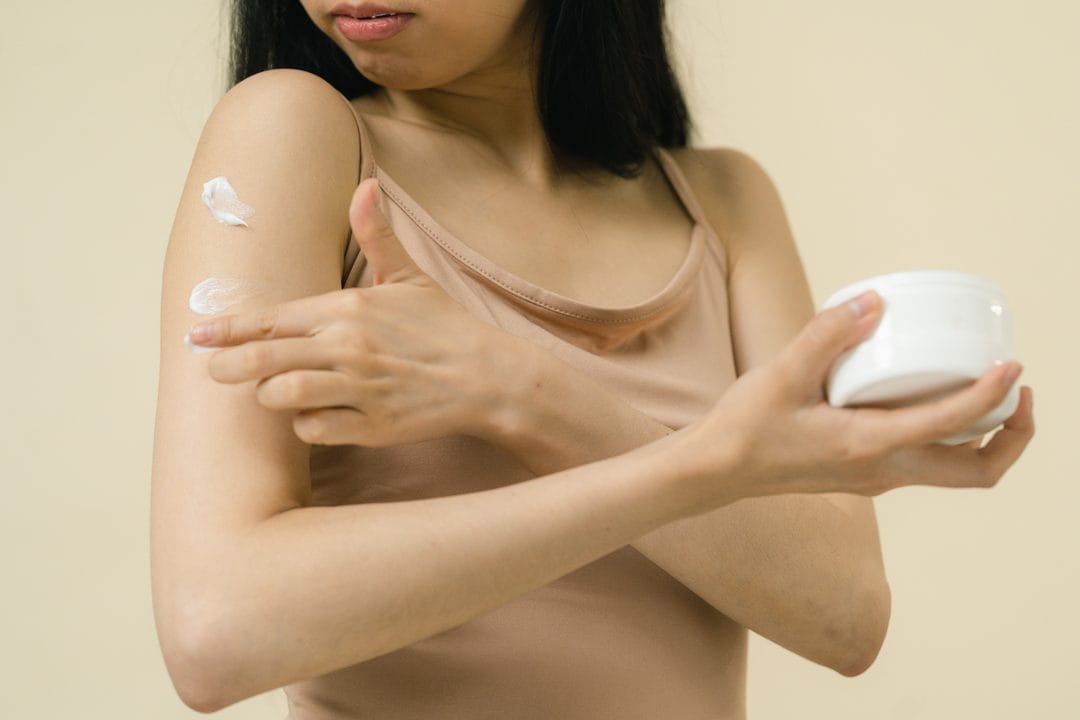
Buy the wrong self-tanner and you'll know it by dinner — not because it's too dark, but because it's the wrong color entirely, a flat orange-brown that sits on top of skin instead of looking like it came from underneath it. The active ingredient responsible, dihydroxyacetone, has been in self-tanners since the 1960s and hasn't changed. What has changed is how brands buffer it, and understanding that difference is the actual reason one $24 drop formula can look more natural than a $46 mousse, and vice versa, depending entirely on your skin and how you apply it. Most people blame the brand when a tan turns patchy, and most of the time that's the wrong place to point the finger, because the chemistry underneath nearly every self-tanner on the shelf is identical. What differs is concentration, buffering, and the guide color a brand adds so you can actually see where you've missed a spot before the real reaction even starts.
What DHA Actually Does to Skin
Dihydroxyacetone, or DHA, is a colorless sugar that reacts with amino acids in the outermost layer of skin — the stratum corneum — through what's called the Maillard reaction, the same browning chemistry that turns bread crust golden in an oven. It doesn't dye or stain skin the way a cosmetic pigment would; it chemically bonds with dead skin cells sitting on the surface, which is exactly why the color fades on its own within five to ten days as those cells naturally shed. The FDA approved DHA as a color additive for external cosmetic use decades ago, but the approval comes with a specific caveat worth knowing: it's not cleared for use near the eyes, lips, or mucous membranes, and the agency has specifically warned against inhaling or ingesting it during spray-tan applications, which is why a legitimate spray tan booth will have you wear nose filters and lip balm as a barrier. Most drugstore and salon formulas sit somewhere between 3% and 8% DHA, and that range alone explains a lot of the confusion around "sensitive skin" self-tanners — a lower percentage isn't gentler in the skincare sense, it's just a slower, lighter version of the identical chemical reaction. Nothing about DHA penetrates below the stratum corneum, which is also why it offers zero UV protection despite the golden color it produces, a distinction that still trips people up every summer.
DHA vs. Erythrulose — Why Your Tan Develops on Different Timelines
Most self-tanners on shelves today aren't pure DHA. They're blended with erythrulose, a related keto-sugar that reacts through the same Maillard pathway but far more slowly, which is why erythrulose-heavy formulas are marketed as "gradual" tanners rather than instant ones. DHA alone develops most of its color within one to three hours and finishes darkening by hour eight; erythrulose can take a full 24 to 48 hours to reach its final shade, but the color it produces tends to look more even and lasts a few days longer once it does show up. That's the real trade-off, not the marketing language brands use to describe it: fast-acting DHA formulas reward good application technique because mistakes show up almost immediately, while erythrulose-blended formulas are more forgiving of a slightly uneven first coat because the color builds in slowly enough to correct with a second pass the next day.
Here's the part that actually explains the orange problem. DHA's reaction rate is sensitive to skin pH and to how much dead, dry skin cells are in the stratum corneum when it's applied, and higher concentrations react faster and darker, not necessarily better — which is why a product with 8% DHA doesn't automatically outperform one at 5%, it just develops faster and punishes uneven application more severely. Dry patches on knees, elbows, and ankles have more dead cell buildup than smoother skin on the thighs or stomach, so DHA reacts more intensely there and produces exactly the blotchy orange knuckles and ankles that give self-tanner its bad reputation, regardless of which brand's bottle it came out of.
The Products Worth Comparing, and What Actually Separates Them
Isle of Paradise Self-Tanning Drops run about $24 to $26 and work by mixing a concentrated DHA serum into your regular moisturizer, which dilutes it into a more forgiving, buildable formula — a genuinely good starting point if you've been burned by orange ankles before, since you control the strength every time you mix a batch. St. Tropez's Self Tan Bronzing Mousse costs closer to $46 and uses a cosmetic bronzer alongside its DHA, so you get an immediate guide color that shows you exactly where you've applied unevenly before the real DHA reaction even starts — that visual feedback is worth the extra cost if you've ever missed a patch on the back of your leg. Tan-Luxe's The Water Hypoallergenic Self-Tan runs around $44 and skips fragrance and several common irritants, which matters if you've reacted to other self-tanners with itching or breakouts, though it doesn't develop any faster or slower than a standard DHA formula at a similar concentration.
Skip the products claiming "instant color correction" or promising a tan that "adjusts to your unique skin tone" — DHA reacts with everyone's stratum corneum roughly the same way chemically, so any formula claiming to know your specific undertone in advance is selling a story, not a different mechanism. Exfoliate the night before with a washcloth or a mild body scrub, moisturize dry areas like knees and ankles twenty minutes before applying so DHA reacts more slowly there, and use a tanning mitt rather than bare hands — palms have thicker, denser stratum corneum than anywhere else on the body, and DHA will turn them a shade darker than the rest of you almost every time if you skip the mitt.
What Actually Goes Wrong, and How to Fix It Mid-Tan
A patchy result almost never means you bought a bad product.
It usually means the application went on unevenly across skin that wasn't uniformly prepped, since DHA has no ability to correct for that on its own — it just reacts to whatever surface it lands on. If you notice streaking within the first hour, a damp washcloth can still lift some undeveloped product before the reaction sets fully; after eight hours, though, you're working with a finished result until it exfoliates off naturally, and scrubbing at that point will just create lighter patches rather than removing color evenly. Baking soda paste and lemon juice are popular internet fixes for over-dark patches, but neither is doing anything DHA-specific — they're just mildly exfoliating or acidic enough to strip surface cells faster, and a proper AHA-based body exfoliant does the same job with less risk of drying out skin that's already stressed from a bad application.
How Long It Actually Lasts, and What Speeds It Up
Most DHA tans hold their color for five to seven days before visibly fading, and that window shrinks fast if you're showering with hot water, using body wash with sulfates, or exfoliating regularly, since all three accelerate the skin cell turnover that DHA color depends on. Swimming in chlorinated water fades a tan noticeably faster than a regular shower does, which is worth planning around if you're tanning for a specific event rather than as an ongoing routine. Apply your next coat over color that's still mostly intact rather than waiting for it to fade completely — building thin layers every three to four days keeps the color even, while letting it fade all the way down and reapplying from scratch each time is what produces the uneven, patchy re-tan most people blame on the product instead of the timing.